Showing posts with label Savings. Show all posts

Wednesday, 5 March 2025

Spending for Feb 2025: Nearly Maximise Maybank Credit Card Cashback (7% cashback)

Spending Performance for Feb 2025

Total expenditure was $834 with $61 in cashback clocked (7.3% cashback). This is close to the best of my ability to fully utilise Maybank's credit card cashback system.

Grocery Spending

My basic neccessities spend remains high, of course this is due to the high cost of living in Singapore :p

This category's spending exceeds the cap Maybank has at each (per) category, however, I have been actively trying to cut my food ingredient expenses etc to ensure a minimalist lifestyle. Mirroring myself like a company, I am guiding for my recurring grocery expenditure (maintenance CAPEX) to be at $300-$350 monthly range.

Transport Expense

Transport will be at the $80 monthly range. Otherwise nothing to report and thanks to inflation, my expenses now allow me to utilise Maybank's Family and Friend's Cashback; previously hitting $800 monthly expenses was a stretch, now it is easier. Good thing or bad thing, its debatable. 

Fortunately due to my resourcefulness, I have cushioned the cost of living crisis with my skill set in the realm of credit cards.

<Non Sponsored Post on Maybank Credit Cards> 

Saturday, 11 January 2025

Credit Card Spending Strategy for 2025- Using Maybank Family and Friend Credit Card

As someone who loves to stretch my dollar, my spending has revolved around using 3 credit cards to chase both air miles and cashback, it was a good strategy which enabled me to get free air flights on premium seats on SIA for the past 2 years after COVID. This was how my spending revolved:

Nerfing of Many Credit Card Benefits

If 2024 is anything to remember, it is that many banks have Nerf'd their credit card benefits. HSBC revolution was the worst where 2024 started with the removal of paywave earning 4 miles per dollar (which forced me to rotate my UOB's lady card each quarter by quarter to plan how I would spend/eat). 

Standard Chartered Bank has now too moved to kill off the generous 6% cashback (with no minimum spend) I was obtaining for my EZ Link and Ya Kun Coffee buys; while I could still earn a generous 8% cashback for EZ link and Ya Kun if i spent $800 per month, it is unlikely I will be drinking myself silly on Ya Kun Coffee per month

New Main Card- Maybank Family and Friend Credit Card

The benefits of Maybank Family and Friend has been around for a few years. It's 8% cashback for chosen categories with $800 minimum spend per month is generous and has always been a close contender for me to go full cashback. However, I have not consolidated my spending to this card, because I had struggled to charge $800 spend per month on credit cards. So why have I decided to move to Maybank Credit Card for 2025?

Singapore Inflation is High that I Can Meet The Target

To qualify for the 8% cashback, Maybank requires users to spend $800 per month. By a stroke of luck, the constant inflation in Singapore has increased my cost of living that it now hits Maybank's minimum spend!

My grocery expenditure forms the largest part of spending because I would buy items and cook my own meals for work. While doing my usual shopping in recent months, I have noticed the bill has increased quite a bit while the purchased items has remained unchanged; hence due to inflation, my expenditure has increased quite a bit. Furthermore with the public transport hike, 2025 spending now moves close to the $800 mark

My plan now is that some front loading to purchase NTUC Vouchers has to be done to hit the $800 minimum spend per month. And for a month or two, I would not charge grocery to the card but instead charge for my flight expenses (since I am now going to full cashback, I will not have the miles to fly for free).

With a consolidated spending on primarily one credit card, I am able to track my spending with greater accuracy, let's see if I am able to utilise Maybank's Cashback reward effectively to maximise my daily spends. 

Saturday, 6 May 2023

The Best Fixed Deposit Rates in Singapore for above/at 3.5%

Currently many are lamenting about the low interest rates they are receiving from fixed deposits.

I find this not entirely true because beyond the 3 local banks, many foreign banks are giving good rates for their FDs; just that they are not being advertised. This is likely due to them not being particularly bothered with Singapore's market.

Best Banks to Put Your Money Now

Singsaver has done an up to date almost awesome list, so credits to them!

The best banks to put Fixed Deposits of 12 months duration now:

$1,000- $10,000 Range: ICBC Singapore Bank, if over the counter at the branch: Bank of China Singapore

$10,000- $100,000 range: ICBC Singapore Bank, if over the counter at the branch: Bank of China Singapore

[No typos here!] but I notice its the chinese banks currently giving the best rates at 3.5-3.6%.

Besides them, CIMB and RHB are giving good rates too

First $75,000 at Each Bank is insured and You will Get it Back

These banks are insured under the Singapore deposit insurance scheme. So whatever money you put in (of first $75,000) is insured and protected!

Furthermore, these foreign banks are rather large to the extent that I would recommend investing in one of them over DBS or even OCBC (see my post here). ICBC has a very strong balance sheet, is well captialised and profitable. So it is rather safe to place a FD with ICBC; though i would recommend buying their shares instead!

SORA Rate is Pointing to 3+% interest

The Singapore Overnight Rate Average (SORA) determines the rates new loans are issued. New loans tend to be issued above SORA rates. Effectively SORA is similar to Singapore's risk free rate.

Currently the 3 month SORA rate is 3.6% (based on MAS data)

Hence, it is likely most other banks will soon be offering rates close to 3.6%. For now, I will highly recommend putting majority of your wealth with the Singapore branches of these Chinese and Malaysian banks. 

Given that there is SDIC insurance, your fixed deposts are relatively safe.

Look beyond the 3 Local Banks

Many of us grew up with these 3 local banks (DBS/OCBC/UOB) being known to us and have remained banking with them. However, the turth is that if you look beyond them, there are other banks which are offering better rates which helps to accumulate your wealth faster.

Hence as individuals managing our own money, it is important to be aware of the existence of other banks and use the opportunity to bank with them to compound your wealth faster. Personally, I am using a Malaysian Bank as well due to this factor.

Sunday, 19 July 2020

How to earn a Higher than Bank Interest for Retirement

Many of us know what is CPF because a portion of our pay is always "locked" to it. But in the current low interest environment, did you know the CPF system is probably the best money hack available to grow our wealth for retirement? One way is through the CPF Retirement Top Up Scheme. 

CPF Retirement Sum Topping Up Scheme (RTSU)

CPF RTSU is a scheme which allows us to make voluntary cash contributions into our CPF Special Account (CPF SA). The money goes into your SA which then grows over time.

If you like most Singaporeans have to continuously work to make ends meet, there is an extremely high chance that at age 55 (or later), you will be able to withdraw and enjoy the RTSU top up amount you have put in.

Benefit 1: High and Stable Interest

The CPF Special Account gives you 4% interest and is backed by the Singapore Government. In short, you are buying Singapore government bonds which continuously yields 4% each year that you can withdraw at 55 (or opt to continue holding post-age 55 to enjoy the 4% interest). 

If you do an RTSU top up at age 25, its the same as buying a Singapore bond of 30 years. 

In the current market, private investors have to accept a 1.3% interest yield when investing in a Singapore 30-year bond, however we as CPF Account holders get to enjoy a 4% interest ! CPF has never lowered the SA interest to be lower than 4% since 2000.

Even among banks, there is no bank that is offering such a high interest rate for their personal banking accounts or FDs (in fact many banks are lowering their interest rates for accounts)

Below is a comparison of Singapore Bond Yields vs CPF:
                    ^Data Extracted from MAS website on bond yields.

Benefit 2: Top up early and you will be in a much better position than others

Let's create two hypothetical person in the world: Jack and Daniel. Both earn the same pay and progress the same; the only difference is that Jack puts in $7,000 annually in his RTSU from age 30-39. Here is the low down: 


If both of them decide to work until 65 and only start to withdraw their CPF SA, the difference in their CPF SA balance is going to be huge.

At age 65, Jack has an approximate $220,000 head start over Daniel to enjoy for his retirement. This was due to Jack's decision to set aside $7,000 yearly from age 30-39 to prepare for retirement.

Benefit 3: Tax Savings in the Present 

The first $7,000 you top up each year allows you to enjoy tax savings. This will be automatically filed into your annual income tax assessment.


However not Everyone Qualifies for it

CPF has an annual contribution limit of $37,740. Any money that you top up into CPF and exceeds the contribution limit will be refunded to you and you will not enjoy any of the above benefits. This means only those earning $100,000 and below annually can enjoy this.


In addition, if your CPF SA balance has exceeded the value of the current full retirement sum ($181,000 as of now); you will not be able to do RTSU.

Act on It!

Based on the above information, it is perhaps wise to start RTSU in your 30s to 40s. This is because if you start too early at the early 20s, your money is going to be locked in for a long duration of 30+ years. However if you do it too late at say age 50, there may be a chance that your CPF SA has exceeded the full retirement sum and you will not be able to top up or there is too short a time frame for your money to compound by leveraging on the high interest yield of CPF SA.

So plan your retirement and remember out there, there exists a scheme called the RTSU - available for many ordinary folks like us to act and take advantage of. 

Monday, 4 September 2017

Saving $100,000 by 31

“How do I start to reach my financial goals?”

“What must I invest in?”

These are questions often asked as newcomers to the workforce embark on their goal to start saving for retirement. And the first steps to it is saving with a certain figure in mind. So how can one achieve this first financial milestone of saving, say their first $100,000? While many would think the ability to invest smartly is required to achieve this goal, the truth could not be any further.

Its more about Saving Habits than Smart Investing
In my view, if you have the goal of saving $100,000 before the age of 35 (or preferably 31), achieving your milestone depends more on how much you save than the ability to invest for wonderful returns.

Let’s use the example of “Ben” to illustrate. Following the path of most university graduates, Ben graduates and enters the workforce at the age of 25. There he attains a job with a monthly salary of $3,000 (After CPF: $2,400). Ben expects an annual 5% increment during the early stages of his career and intends to save a full 1 month of his bonus annually. In addition, being a new investor, Ben expects to invest in “safer” stocks which will yield him an annual investment returns of 4%.

Under $1,000 Monthly Expenses
As mentioned, Ben intends to keep his personal monthly expenditure to under $1,000 or about 40% of his take home pay. This is how his monthly expenditure will look like. Do note that while the insurance expense is low at $45, this is because term coverage of $200,000 and hospitalization insurance is utilized.

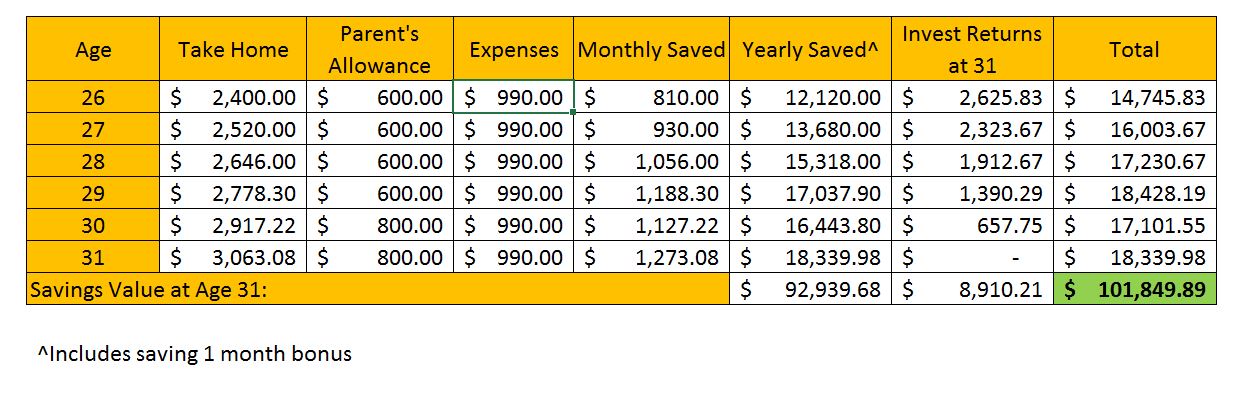
All in all, Table 2 shows how much Ben will save monthly. At the start of his working life, he is saving only about 30% of his monthly take home pay.
Table 2: Saving Table at age 26 & 30

Based on the calculations, Ben will save
$100,000 when he is 31 years old.

Analysis of how Ben achieved his $100,000
Based on Table 3, a significant portion of the $100,000 was due to Ben’s savings. In fact, only $8,910 was a result of his investment returns. To summarise, 91% of Ben’s financial milestone was due to his efforts of keeping monthly expenses low (below $1,000); enabling him to save 30-40% of his take home pay.

What if Ben had been Given Wrong Financial Advice or Spent More?
Let’s put additional thoughts to the above example. How would Ben’s milestone of $100,000 be affected if instead of spending $990 monthly, Ben spends $1,340 monthly. The reasons can vary such as instead of being advised to take Term insurance, Ben was offered Whole Life insurance (which will cost him $350 more monthly for the same coverage) or Ben simply decides to spend $350 more to pamper himself.

From a spending ratio of 30-40% of his take home pay, Ben’s spending ratio has now increased to the 43-55% range. Correspondingly, this will affect his savings ratio (a decline from an average of 39% to 26%).
Table 4: Saving Amount at reduced Saving Ratio

At age 31, Ben will only be able to save $73,991. Hence, just a decision to 'spend more' or 'an advice to choose Whole Life instead of Term' sets him back a difference of $26,000. Ben has been delayed by approximately 2 years in achieving his financial milestone of $100,000.

Conclusion
To summarise, the financial milestone of $100,000 depends greatly on what you spend and the amount you save. From Table 3, it shows just how little investment returns contributes. It is only if we take a longer term horizon, will the compounding of investment returns be substantial to contribute to our wealth building. However, for our investment returns to be significant, we need to build a large capital base and this boils down to an individual’s spending and savings habit.

Lastly, some individuals (particularly insurance agents) will dispute the later part of this post where I have “expense” the differential where Whole Life insurance is involved. It is worth noting for individuals who purchase such policy, they will never get to see their maturity sum, hence such a sum/differential should never count towards their retirement fund. Suggestions such as surrendering the policy when they are older (i.e. age 65) may then be offered; however, such a surrender comes at a penalty, and it reduces the returns of whole life insurance to the region of 2-3% per annum. If that is the case, investing the differential on your own is a much better option.

Wednesday, 23 August 2017

When can Whole Life Insurance be better than Term Insurance?

The topic of buying Life Insurance popped into my mind again recently when the Straits Times covered a topic of how Insurance Product options have expanded online and how it can be purchased without the need of going through agents. So perhaps it is a good time to re-evaluate when Term Insurance is better; and when Life Insurance is better.

Previously, I did a short write up of the common types of Insurance shown which can be read here. Hence if you need a basic understanding of how Term and Life insurance works, you may read it before continuing this post.

The "Money Psychology" associated with Term and Whole Life Insurance

My conversations with others on the topic of Term and Life Insurance has unveiled an interesting observation. Many individuals do not consider the value of their Whole Life Insurance policy when calculating their net worth or for retirement. This is intuitive because you yourself will never get to see the sum of money since... oh well you know. Hence many people view life insurance as an expense, whose premiums unfortunately form a significant portion of their take home salary.

Conversely for Term Insurance, as the premiums paid is so much lower than that of a Whole Life, one is able to save more. Currently, the premiums for a term insurance is approximately s$150 per year for a $100,000 coverage, while the premium for whole life insurance is about s$2,200 yearly. This means a savings of about s$2,050 yearly. 

This is one of the reasons why you see a few bloggers possessing a 6 figure investment portfolio despite being in their late 20s or early 30s. It is simply due to the fact that they (we) use term insurance to insure ourselves instead of Whole Life (and also our high propensity to save ratio). As a result of this, society seems to think we are in a better position to retire early and better.

Let's show it mathematically through two individuals who plan to insure themselves for a $200,000 coverage - Mr T (who will utilize Term insurance) and Mr WL (who will use Whole Life). In a short span of 10 years, assuming a return of 4% earned on the difference, Mr. T will be ahead of Mr. WL by $49,225.
                              
Savings over 10 years at 4% Average Returns

To summarize, individuals do not view Whole Life Policies as part of their retirement fund despite the premiums paid being much higher than that of Term. On the other hand, those who purchased Term insurance are able to see the tangible difference by a faster rate of accumulation in their bank balance; and if they were to invest wisely this difference, they will have a higher net worth compared to individuals on Whole Life. This sums up the "money psychology".   

When can Whole Life Insurance be better than Term Insurance?

So the question beckons? When can Whole Life be better?

The answer boils down to the individual - i) when the individual is ill-disciplined in savings or ii) the individual is not very good in managing his money/savings.

Following from my above example, an individual will have an extra $4,100 yearly. He can either a) Save this amount or b) Spend it away. An individual who is indiscipline at saving or poor in managing his money will do exactly b); spending it away for present consumption and not saving for retirement.

Seen in this light, one will notice that Whole Life Insurance is in fact a form of "Forced Saving" scheme. This is because it takes a significant amount of your take home pay now, locks it away until the end of your life to help you benefit from the magic of compounding. Unfortunately, the downside is that you will not enjoy the maturity sum, only your beneficiary.

The Returns from Being Locked Away

So what do I mean by saying an individual is not good in managing his savings? Well it means not knowing how to put the money saved from term insurance into good use (returns). While Whole Life publishes that their projected returns are 4.75% etc, readers will know that the true returns for many such policies are approximately 4% per annum.

If an individual has the discipline and is able to make use of schemes such as POSB-invest saver or ETF to invest in a basket of  shares belonging to companies of credible financial strength, achieving a long term average of 4% is achievable and feasible.

Similarly, if an individual is terrible in investing such that he is always making negative returns annually, then Whole Life might be a better option of locking away his savings for accumulation. However, an altering of his psychology has to be done to come to the realization that the maturity sum from his whole life is part of his retirement plan. Alternatively, he can try to surrender his policy near his 70s to use the proceeds to fund his retirement. 

However surrendering a life policy is not the best option because it reduces the returns to the region of 2-3% per annum; which is pretty achievable if you had started by putting money in your CPF special account at the beginning (CPF SA provides 4% annual returns). 

Summary

If you lack the financial discipline to save or is an individual who is unable to control one's own expenditure, Whole Life may perhaps be a better option scenario. This is because it acts as a form of "Forced Savings" that locks away part of your income for the future. Similarly, if your savings is generating less than 2% interest per year, utilizing a Whole Life policy to help in retirement planning may be an option as well.

It is at this juncture, that I would suggest to tap on another form of forced savings - topping up into your CPF Special Account. This is because it earns a close to risk free 4% returns with the benefits of a one-time tax deductions. However, there is a cap to how much you can top up into your CPF-SA.

Related Link: http://investmoolah.blogspot.sg/2015/09/this-is-better-than-singapore-savings.html


Monday, 21 August 2017

Spend Less on Bubble Tea if you want to be rich and healthier


Most people would have heard about the money hack on cutting back on Starbuck's latte to increase your savings.

Some will have recently heard about Australian's Millionaire Tim Gurner rant on Advocado Toast and how it is making millennials poorer.

Locally too, we have a beverage (food) that is making Singaporeans poorer.

The Bubble Tea

Initially, I wanted to paste a picture of LiHo's or Gong Cha's Bubble Tea; however to avoid potential lawsuit for damaging their business, i guess better not! So down to the facts.

The Bubble Tea is a favorite Singaporean beverage and costs about $3- $3.50 per cup, especially among the younger generations. If an individual decides to reduce the occasions he drink on a weekly basis say from 5 times to only once. The annual savings will be: $3X 52X4 = S$624. That translates to about 20% of a young office worker's monthly take home pay.

And that's not all !

The Potential Health Downside to drinking too much Sugar Drinks (e.g. Bubble Tea)

Initially, I wanted to paste a picture of PM Lee's National Rally and the 'war on diabetes"; however to avoid any potential flaming by netizens of political affiliations etc, i guess better not! So down to the facts.

Recently, PM Lee delivered a somber fact that diabetes is becoming increasingly prevalent among Singaporeans. Let's face it, getting diabetes drains you financially because you will have to pay for the medical treatments, consultations etc. 

And general knowledge tells you one of the main reasons why you get diabetes is because you have consumed too much sugar in your lifestyle. That's where the nasty bubble tea fits in - it has many cubes of sugar (even if we order at 50% sugar).

Hence while cutting down on drinking bubble tea provides you the instant savings of $624 annually, it also reduces your risk to diabetes, preventing from having to bear the financial strains of incurring medical expenses for diabetes.

Summary

To summarize and to build on and quite fellow blogger, Kyith's words: Diabetes can be traced to as a function of affluence and if you look at the insatiability of Singaporeans to go for gong cha, koi, llao llao. The hunger for such snacks borders on addiction and is becoming a problem.

Cutting down on such sugary treats will not only reduce our risk of health problems in the future. It will also save us money in the present. No doubt we Singaporeans are becoming more affluent; however our hunt for food filled with sophisticated and deep flavors should not come at too high a price, damaging our health and financial freedom goals. 


Saturday, 15 July 2017

How a trip to Courts offered me Personal Finance Lesson and its Company model

Recently, my laptop that had accompanied me since my last year of university has been acting up; a sign that a tech refresh to a new laptop may be needed. So I was off for a window shopping trip to identify a laptop good for writing and reading annual reports.

Flexi Plan (which will put you to ruins)

One of those that caught my eye (because it was literally big) was a Lenovo 15.6" inch laptop. It screen size was big and ideal for staring at annual reports and investing forum. Not sure if it was reasonably priced, but it was going selling for $1,499; but what caught my attention even more was Court's Flexi Plan, an installment plan

Apparently at Courts, you can buy many items on installment; and for this laptop, it was being offered on a 60 month installment plan for $61 monthly. 

While the monthly installment sum seemed small, the maths didn't add up. For the laptop on installment, I will be paying a cool $3,660 after 5 years for it. 

Courts Business Model  

Courts has a pretty unique business model- 1) It sells furniture and IT accessories at its retail price for a small margin and 2) It sells furniture and IT accessories in installments at a high margin. Essentially courts is a financier offering consumers "money" to buy items at a loan shark high rate. In fact, in its recent full year results, Courts proudly presents its revenue mix.


Fortunately for the Singapore segment, a small but still significant portion of consumers are tapping on Courts's Installment Plan to finance their furniture and IT accessories purchases. In my opinion, that is still a crazy amount of people taking themselves on a journey of financial ruin.

Of course, to shareholders of Courts Asia, this is music because Courts is able to earn a fat profit margin as it is lending money to consumer at a high interest rate.

Flexi Ruin Plan

Back to my laptop plan. A simple maths will show that over the installment plan, I will be shelling out $3,660 for the laptop if I do not pay $1,499 for the laptop upfront. That is nearly 244% of the upfront retail price Courts is selling.  For $3,660, I would have been able to afford 2 of the same laptop and still be able to buy a brand new Xiaomi hand phone from the spare change!

Seriously, who are those 18.2% on Courts credit scheme?

Let's reverse the scenario. Assuming you put $1,499 in a bank product and wish to withdraw $61 monthly to fund your retirement for the next 5 years. How much must your $1,499 grow annually to fund this?

The answer is a 45.14% annul return.

If you are to ask me: achieving a 45.14% annual return over the next 5 years is no easy task. In fact even the world's best investors including Warren Buffett wont be able to match that. So why should consumers punish themselves by being on these monthly installment plan which are charging a hefty rate (even more than credit card interest)?

No doubt, it is likely there are many people who will default on Court's Installment Plan but that is because the hefty interest rate is killing them. The above is a simple example of a bad debt and how you can lead yourself on a path of financial ruin.

Friday, 1 January 2016

The "Onepunch" Financial Training

Image result for one punch man image

For those who have not watched "one-punch man"; Saitama (the main character), is the most powerful hero who blows villains away by his superhuman strength in punching. When being questioned on the origins of his superhuman strength, Saitama replies he of his daily repetitions he does without fail:
Saitama training

  • 100 Push-ups
  • 100 Sit-ups
  • 100 Squat
  • Run 10km 

And no matter how tough the training gets, he never stopped hit not even for a single day. It took him three years to reach that strength and perhaps, the strengthening of his mind. 

Maybe "one-punching" our way to financial freedom could be simple too. Instill financial discipline, sprinkle some repetitions, never give up on the regime and we become "powerpuff hero". 

So without further ado, here's the (possible) secret recipe to financial superpowers.


Save 20% of your monthly bonus 
You would have probably heard this phrase over and over again: "Income - Saving = Expenses". So yes, just save 20% of your take home monthly income (and 100% of your bonus). Always save 20% of your income first before you think of other expenditures. To summarise, save 20% of your take home pay and feel free to indulge with the remaining 80%.


100% employment 
If possible, keep working until you are 55. This is because when during the initial stages of your working life, your invested capital is very small. Any magnitude in gains and losses in your portfolio will not be as great as the amount of savings you add. 

Quoting from the business insider: 

"Buffett made $62.7 billion of his $63.3 billion networth after his 50th birthday. $60 billion — nearly 95% — is from after his 60th birthday."

This shows how the compounding effect on your wealth will only be significantly felt after you have amassed a sufficient amount of capital.

100% on term and medical insurance
Focus your insurance expense/need into buying only term and basic medical insurance (Don't buy any other kind of insurance for now). This insurance expenses should be part of your "80% expenses".

100% of what is saved equally into STI ETF and CPF 
Do it monthly. While people will ask what happens to the money in your CPF, let me share. Firstly, the money you deposit is automatically set aside for your minimum sum. This means when you turn 55, you can't withdraw the money if the rest of your CPF savings don't meet the minimum sum. 

However, if you have been working till 55 and earn about $2,500 per month, it is likely you would have met the CPF basic sum ($80,5000 currently) with ease, especially for Singaporean males. Using a simple illustration: 


CPF savings: $100,000; Contribution into CPF under this plan : $40,000

Assuming you decide to go with the minimum sum of $80,500. The $40,000 you have deposited on your own will be first used for the $80,500. This means the other $40,500 will be taken from your "$100,000 CPF saving", allowing you to opt for a withdrawal of $59,500.

If you are gungho enough and wish to skip the complexities of the CPF system, just channel the entire 20% into the SPDR STI ETF.

Train your mental resilience
Ignore those "trading seminars which promises high profits", keep to the regime. Alternatively, you may be tempted to take a break and indulge or your friends may suan you. But no! Keep to this regime! 

You are already indulging with 80% of your take home pay.

A small Diclaimer

However, I will like to do a disclaimer: " I do not think the STI will do well in the short run, the key is to buy in monthly as over the long run, the SPDR STI ETF has always done well - about 6.6% annual returns since its inception in 2002." Hence, I believe this strategy will outperform the numerous financial plans out there over the long run.

(*The author is merely a "B-ranked hero" who just started out on the hero journey. He is only a financial hero as a hobby, so please don't take him too seriously. Please note the publication of posts is solely for informational purposes and is not to be construed as a solicitation or financial advice)


Saturday, 3 October 2015

Steps to take to accumulate more wealth

Some have asked how I had accumulated $200,000 at a young age. Below were some steps I took.

Save a significant portion of salary

Don’t live a paycheck to paycheck lifestyle, save a portion of your salary for investments and future consumption.

Don’t put too much Money in Bank accounts and FD

I hate putting a lot of money in saving accounts because the interest rates of these accounts are very low. The only advantage saving accounts have is the liquidity it provides. I suggest to place approximately $10,000 in these saving accounts unless a major expense is coming. This is because $10,000 equates to approximately 3 months expenses incurred by ordinary Singaporeans.

The rest of the money should be placed in Singapore Saving Bonds (SSB) or stocks. This is because the SSB provides a higher interest during the initial years and this interest becomes higher if you keep it with government longer. Furthermore, the SSB is relatively liquid where you are able to make a withdrawal in one month. This will be handy in situations where you need the money. Also, there are no conditions we have to meet to enjoy these returns unlike the OCBC 360 and UOB account. 

For starters, I will recommend Singaporeans set aside some money to bid for SSB once a year. Fixed Deposits in banks are a definite no no given the current climate. They lock you up for a period of time and offer rates only in the region of SSB's. I will only consider SGD denominated FD if the interest offered is at least 2% per year.

Buy Term and Avoid Whole Life/Endowment/ILP

I have shown how buying a term policy and investing the rest in CPF and STI ETF is likely to yield a better return than whole life. You can read it here. This method is likely to empower you to accumulate more wealth than insurance plans.

Investing when Young

This is very important. Investing does not mean putting money in bank FDs or insurance policies. It is to invest in the stock market.

Yes, the stock market is a casino to the layman. However, there is still a way to grow one's wealth in the stock market. That is via the SPDR STI ETF or Nikko AM ETF. Both are index funds and are good instruments to help grow your wealth.

For individuals with a sound understanding in finance and accounting, it is likely the stock market will not be a casino to you. This is because the wealth of experience and knowledge you have accumulated will help discern between the value traps and stocks with true value. If discerning these stocks are still a challenge, it is advisable to stick to the 2 ETFs mentioned above.